
Arc Flash Hazard Analysis
Protect your workers, your equipment, and your operations with a certified arc flash hazard analysis. Identifying and managing arc flash risks is essential for maintaining safe, secure electrical environments across industrial, commercial, and residential facilities.
Licensed, Bonded & Insured
NEC Code Compliant
Same-Day Emergency Response
Permits Pulled & Inspections Managed
Workmanship Guarantee
Serving All of Indiana
5 Highlights on Arc Flash Hazard Analysis
Incident energy calculations done right
Kochs Electric measures available fault current at every panel, switchgear assembly, and MCC to calculate accurate incident energy levels in cal/cm² per IEEE 1584 standards.
Arc flash labels applied to every panel
Every energized electrical panel, switchboard, and disconnect switch gets a compliant arc flash warning label showing PPE category, working distance, and arc flash boundary.
Single-line diagram development included
We document your full electrical system on a one-line diagram, capturing every circuit breaker, transformer, busbar, and overcurrent protective device.
Protective device coordination reviewed
Our engineers evaluate relay settings, fuse ratings, and circuit breaker trip curves to verify your system interrupts fault current fast enough to reduce incident energy exposure.
Full NFPA 70E and OSHA compliance
The completed arc flash hazard analysis satisfies NFPA 70E, IEEE 1584, and OSHA 29 CFR 1910.333 requirements for working on or near energized electrical equipment.
Why Choose Our Arc Flash Hazard Analysis
Founded by Master Electrician David Koch (Indiana License #EC21400047) and serving Indiana industrial and commercial facilities since 2008, Kochs Electric brings certified arc flash engineers and journeyman electricians to every arc flash hazard analysis. Our team holds NETA (InterNational Electrical Testing Association) certification for electrical testing and carries general liability and workers’ compensation insurance on every engagement. Every phase of the study is carried out in-house – no subcontracting, no hand-offs, no gaps in accountability.
We’ve performed arc flash studies across industrial facilities, commercial buildings, and utility substations. That field experience means we don’t just run software models. We physically inspect each isolation point, verify conductor sizing, confirm transformer ratings, and cross-check metering equipment readings against calculated values. Our professionals bring specific knowledge and actionable insights that software alone cannot produce.
Our arc flash hazard analysis reports are built for real use. Each report includes a complete incident energy analysis, short-circuit study, protective device coordination study, and arc flash risk assessment. Every qualified person on your team gets a document with actionable findings and clear operational outcomes they can act on immediately.
We stand behind our work. If your authority having jurisdiction or safety manager identifies a discrepancy in our arc flash labels or single-line diagram, we return and correct it at no additional charge.
Kochs Electric is a licensed Indiana electrical contractor with NETA-certified arc flash coordinators on staff. We train your team on the results, walk through the arc flash boundaries, and explain PPE category requirements for every panel in your facility. Serving industrial and commercial facilities throughout Indianapolis, Carmel, Fishers, and Indiana – call (317) 680-7907 to schedule an arc flash study.
Recent studies include an arc flash hazard analysis for a 250,000 sq ft Indianapolis automotive parts plant – 47 panels and MCCs surveyed, incident energy calculations per IEEE 1584, and a protective device coordination finding that reduced incident energy at the main 4,000A switchgear from 42 cal/cm² to 8 cal/cm² by adjusting the upstream relay trip time; and a study for a Carmel commercial building whose last assessment was nine years old, including an updated single-line diagram reflecting six panel additions made since the prior study and new arc flash labels installed on every enclosure.
Ready to Get Started?
Contact our licensed team today for a clear, written quote with no surprises. We serve all of Indiana.
Signs You Need Arc Flash Hazard Analysis
Your electrical panels have no arc flash labels:
Unlabeled panels create direct arc flash hazards and put every qualified person at risk. Without proper hazard communication – including a warning label showing incident energy level, arc flash boundary, and required PPE – workers can’t make informed decisions before they open an energized enclosure. NFPA 70E requires labels on all equipment likely to require examination, adjustment, or servicing while energized.
Your facility has added or modified electrical equipment:
Every time you install a new transformer, replace a circuit breaker, or reconfigure a motor control center, the available fault current and protective device coordination can change. An outdated arc flash study may show incorrect incident energy values, putting workers in arc-rated PPE that’s rated too low for actual exposure.
Your utility has upgraded service to your building:
Higher available fault current from the utility means higher arcing fault energy at your switchgear and panelboards. A bolted fault calculation that was accurate three years ago may now underestimate the prospective short-circuit current at your main disconnect switch.
You're preparing workers to perform energized electrical work:
Before any qualified person can receive an energized electrical work permit, your electrical safety program needs a current arc flash assessment and risk analysis. That flash assessment must identify the arc flash boundary, limited approach boundary, restricted approach boundary, and required arc-rated PPE for each task.
Your last arc flash study is more than five years old:
IEEE 1584 and NFPA 70E both recommend reviewing arc flash hazard analysis every five years or after any significant system change. Outdated assessments create compliance gaps, weaken risk management programs, and compromise flash safety for everyone working near energized equipment.
State of Indiana
You don’t lift a finger
Our Arc Flash Hazard Analysis Process
Site walkthrough and data collection
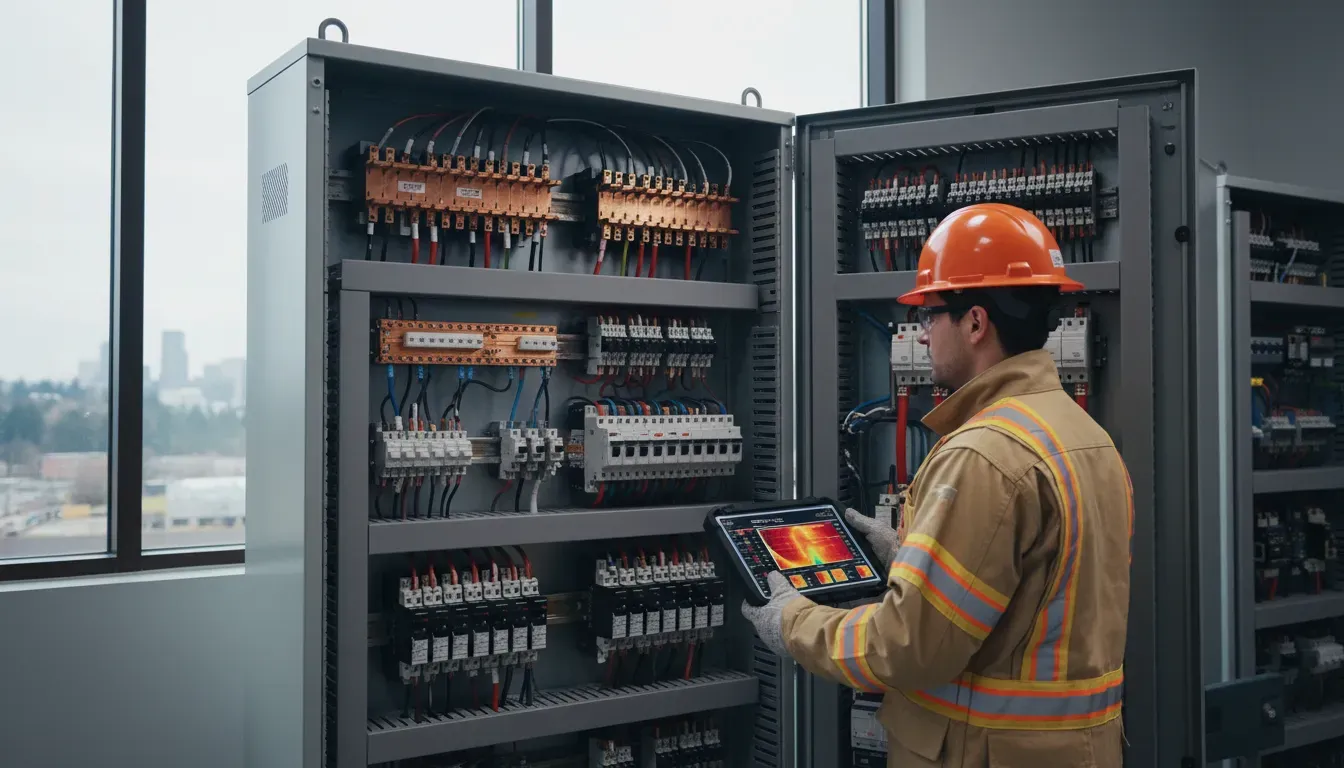
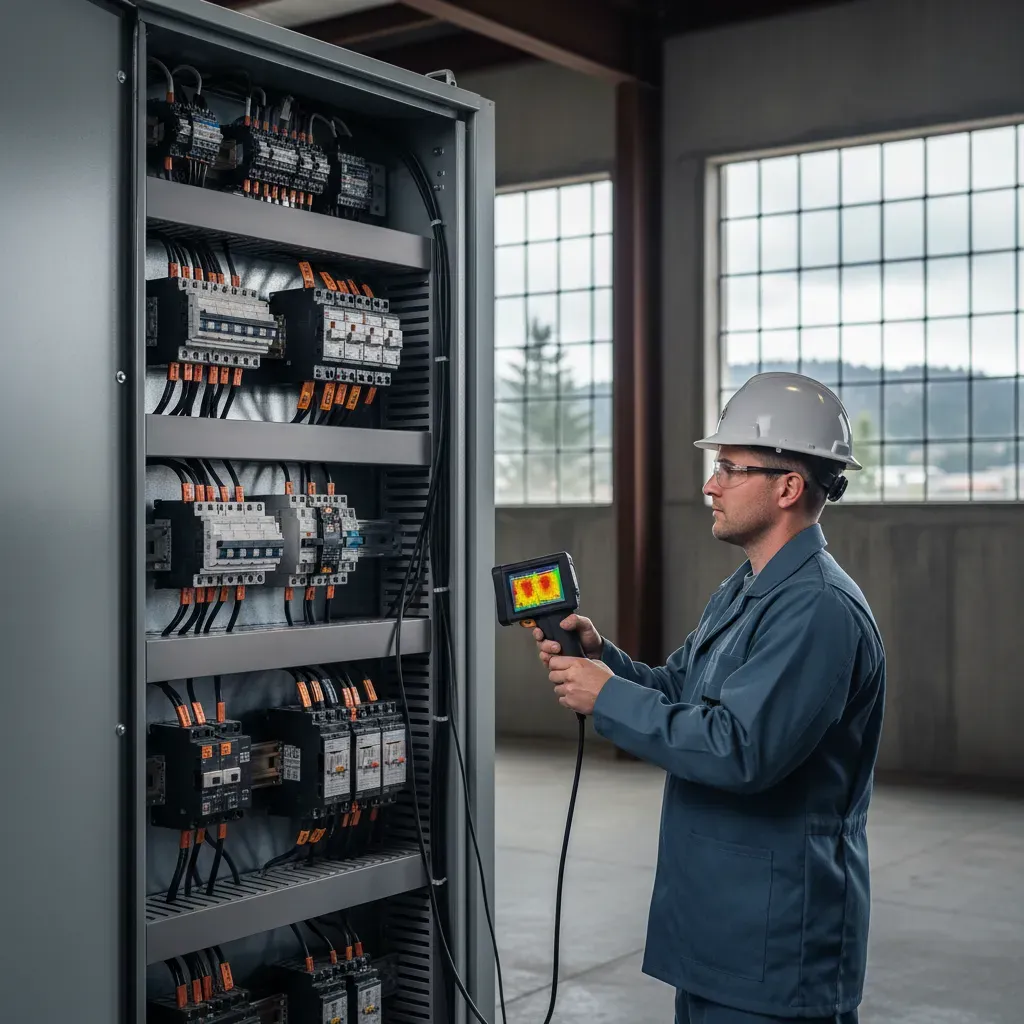
Our electricians inspect every electrical panel, switchgear lineup, MCC, transformer, and disconnect switch. We record conductor sizes, circuit breaker ratings, fuse types, relay settings, and working distances at each piece of equipment.
Permitting For work that requires a permit
Single-line diagram development. We build or update your one-line diagram to reflect the current state of your electrical system, including all overcurrent protective devices, busbars, and energy sources.
Short-circuit study
We calculate available fault current, short circuit current, and bolted fault current at each node in your system using verified utility data and measured impedance values. This short circuit analysis confirms the specific fault levels that drive incident energy calculations at every panel.
Protective device coordination study
We evaluate trip curves, relay settings, and fuse characteristics to confirm your OCPDs interrupt arcing faults fast enough to limit incident energy at each working location.
Incident energy analysis
Using IEEE 1584 modeling, we calculate incident energy in cal/cm² at the working distance for every panel and piece of switchgear, then assign PPE categories accordingly.
Arc flash label production and installation
We print and install compliant arc flash warning labels on every energized enclosure, showing arc flash boundary, PPE category, incident energy level, and working distance.
Report delivery and team training
We deliver the full arc flash hazard analysis report and walk your safety manager and qualified persons through the findings, boundaries, and PPE requirements. This arc flash training – including flash training on boundary enforcement and PPE selection – gives your team the knowledge to support safe, operational electrical work going forward.
Brands We Use
Kochs Electric works with trusted, IEEE 1584-compatible equipment manufacturers and software platforms to carry out accurate, reliable arc flash hazard analysis:








Every brand we work with meets NFPA 70E and IEEE 1584 requirements.
Other Services
Arc flash hazard analysis
Arc flash study
Incident energy analysis
Arc flash risk assessment
Electrical arc flash analysis
IEEE 1584 arc flash study
Arc flash label requirements
Arc flash warning label
NFPA 70E compliance
Arc flash boundary calculation
Arc flash working distance
Available fault current study
Arc flash PPE category
Arc-rated PPE requirements
Protective device coordination study
FAQs About Arc Flash Hazard Analysis
What is an arc flash hazard analysis?
An arc flash hazard analysis is a formal engineering study that calculates the incident energy released during an arcing fault at each piece of electrical equipment in your facility. It identifies arc flash boundaries, required PPE categories and their incident energy rating, and working distances so qualified persons can work safely on or near energized electrical equipment. The study is the foundation of any arc flash safety program and directly supports flash safety compliance under NFPA 70E.
When does my facility need an arc flash hazard analysis?
Your facility needs one before any qualified person performs energized electrical work. NFPA 70E requires an arc flash risk assessment as part of every energized electrical work permit. IEEE 1584 recommends updating the full study every five years or after any significant change to your electrical system, including new transformers, circuit breakers, or utility service upgrades.
Why does arc flash analysis require a short-circuit study?
The incident energy at any panel depends directly on the available fault current at that point in the system. Without an accurate short circuit study, the arcing fault current calculation is unreliable. A proper short circuit current risk analysis confirms the fault levels at each node – without it, the resulting PPE category assignment may be dangerously low.
How does Kochs Electric calculate incident energy?
We use IEEE 1584 modeling software loaded with field-verified data — conductor sizes, transformer impedances, circuit breaker trip curves, and working distances — to calculate incident energy in cal/cm² at each working location.
Can arc flash labels expire?
Arc flash labels don’t carry expiration dates, but they become inaccurate whenever your electrical system changes. An outdated label showing the wrong PPE category or incident energy level is a direct safety hazard. Kochs Electric replaces labels whenever we complete an updated arc flash hazard analysis.
Does arc flash analysis cover shock hazards too?
The arc flash hazard analysis addresses arc flash boundaries and incident energy. NFPA 70E also requires shock hazard analysis, which identifies limited approach boundaries, restricted approach boundaries, and voltage-rated glove requirements. Kochs Electric documents both hazard types in every arc flash study report.
Indiana's Trusted Residential Electricians
Licensed. Insured. NEC compliant. We pull permits and schedule inspections so you don’t have to. Call us today to get started.